
Direct Answer
To set up a URL redirect, decide which URL moves and where it should go, pick 301 (permanent) or 302 (temporary), and add the rule wherever requests for the old URL are answered: your web server, your CMS, your registrar's forwarding, or a redirect service. Then test it. In RedirHub: Create → Domain Redirect, enter Redirect from and Redirect to, choose 301 · Permanent, point the domain's DNS to RedirHub, and HTTPS is issued automatically.
This guide starts with what every URL redirect needs and where you can set one up, then walks through a full RedirHub setup, from signing up to a working HTTPS redirect. For the RedirHub part, all you need is a domain you own and access to its DNS settings. New to RedirHub? Start with What is RedirHub?.
What every URL redirect needs#
- A source: the old URL or domain people still visit, for example oldbrand.com or mybrand.com/pricing-2025.
- A destination: the full URL they should land on, including https://, for example https://mybrand.com.
- A redirect type: 301 when the move is final (search engines move the old URL's signals to the new one), 302 when it is temporary, such as a maintenance page. 301 vs 302 redirects explains the difference.
- A place to run it: the redirect only works on the server that receives requests for the old URL, which is wherever its DNS points. A rule on your new site cannot redirect a domain whose DNS still points somewhere else.
Where to set up a URL redirect#
There are four common places to add a redirect. Pick the one that already answers requests for the old URL, or the one you can point it to.
| Where | How you add it | Best for | Watch out for |
|---|---|---|---|
| Web server (Apache .htaccess, Nginx) | A rewrite or return rule in the server config | Sites you host and can edit yourself | Needs server access; a typo can affect the whole site |
| Hosting panel (cPanel Redirects) | Pick Permanent (301) or Temporary (302), the source and the destination | Hosting accounts with cPanel | cPanel writes the rule to .htaccess, and apps such as WordPress may ignore it |
| CMS or plugin (WordPress, Shopify…) | A redirect manager inside the CMS | Single pages on a live site | Only works while that site keeps running |
| Registrar forwarding (GoDaddy, Namecheap…) | A forwarding or URL Redirect record in the domain's DNS panel | Sending a spare domain to one URL | HTTPS and path handling vary; Namecheap, for example, supports HTTPS only to a different destination domain |
| Redirect service (RedirHub) | Create the redirect, then point the domain's DNS to the service | Domains without hosting, many domains, site moves | Paid: from $49/month, with a 14-day free trial |
Server rules and plugins are covered in 301 Redirect: What It Is and How to Set One Up and How to Redirect a URL in WordPress. For registrar forwarding, see the guides for GoDaddy and Namecheap. The rest of this page shows the redirect-service route in RedirHub.
URL redirect examples#
- Domain change: oldbrand.com → https://mybrand.com, 301, keeping the path, so oldbrand.com/about lands on mybrand.com/about.
- One page moved: mybrand.com/pricing-2025 → https://mybrand.com/pricing, 301.
- Temporary detour: mybrand.com/shop → https://mybrand.com/maintenance, 302, removed once the shop is back.
- Typo or spare domains: mybrnd.com and mybrand.net → https://mybrand.com, 301, every path to one URL.
Whatever tool you use, the browser receives the same thing: a status line such as HTTP/1.1 301 Moved Permanently and a Location header with the new URL, for example Location: https://mybrand.com/about.
How to set up a URL redirect in RedirHub#
The example below sends oldbrand.com (and oldbrand.net) to https://mybrand.com with a 301 and keeps every path. Your DNS and email stay with your current provider; only the records for the names you redirect change.
Step 1: Create an account or log in#
Go to the RedirHub dashboard and sign up or log in. The 14-day free trial is enough to follow this guide.
Step 2: Choose Domain Redirect#
Open Links, click Create and choose Domain Redirect.
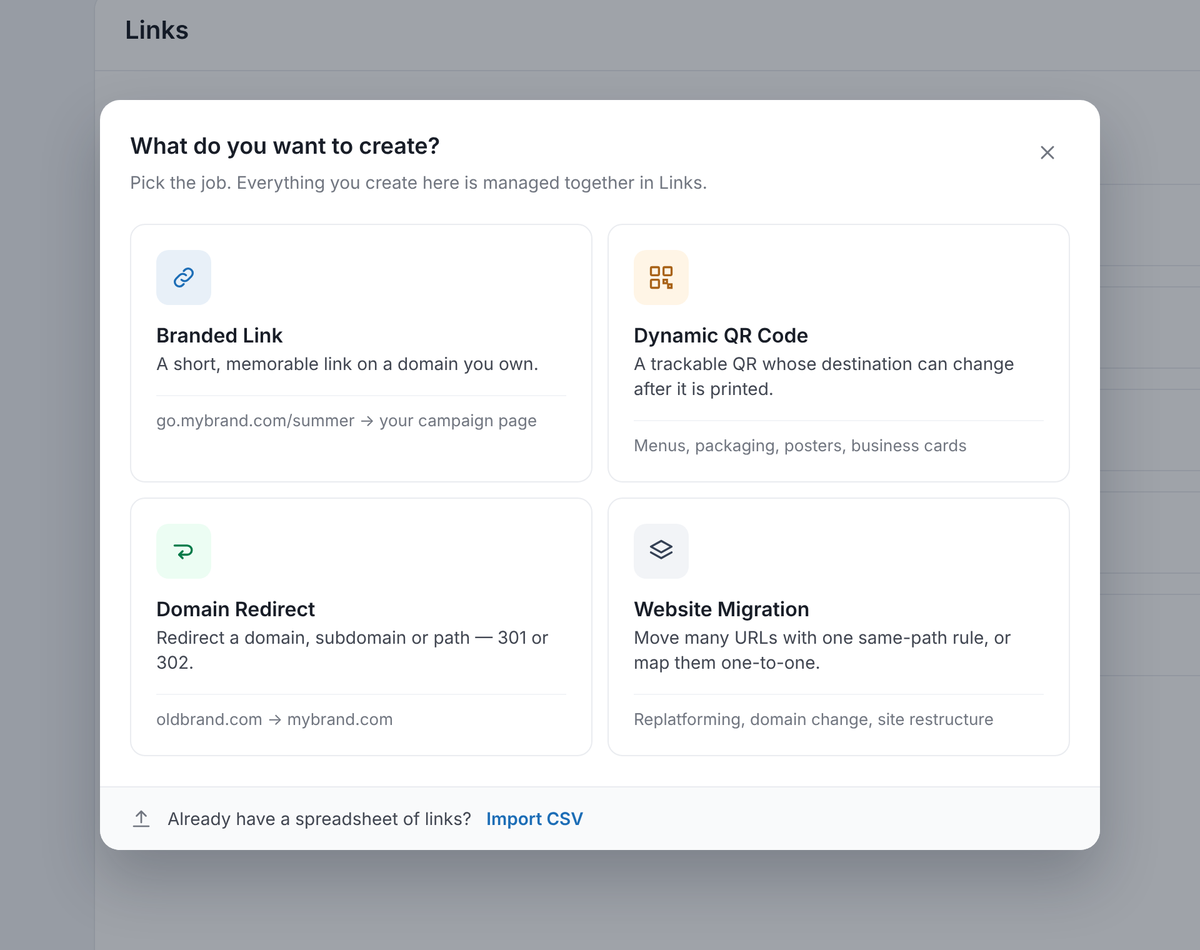
Create → Domain Redirect. The same dialog starts branded links, QR codes and migrations.
Pick the card for the job, not the format: Domain Redirect sends a domain, subdomain or path somewhere else, while Website Migration moves many URLs at once. Whatever you create here is listed and managed together in Links.
The root domain covers www
You don't need to add www separately. A redirect for oldbrand.com also handles www.oldbrand.com, including the same paths, as long as www also points to RedirHub in DNS (Step 4).
Add www as its own source only when it should go somewhere different from the root domain. The root domain and its www version count as one domain on your plan.
Moving a whole site rather than one domain? Choose Website Migration to map each old URL to its own new page during a website migration. Already have the mappings in a spreadsheet? Import CSV at the bottom of the dialog runs a bulk CSV import on every plan and shows the rows, errors and plan usage before you confirm.
Step 3: Set Redirect from, Redirect to, type and paths#
- Redirect from / Redirect to: the domain you own (oldbrand.com) and the full URL visitors should land on (https://mybrand.com). Use Add another source to send more domains, such as oldbrand.net, to the same place. A root domain also covers www.
- Redirect type: 301 · Permanent for moves that are final, 302 · Temporary while you are testing. More types adds 307, 308, Frame and Custom HTML; see Redirect Methods Explained.
- Paths: choose Keep the path so oldbrand.com/about goes to mybrand.com/about, or Everything to one URL to send every path to the destination. Under More options, Query forwarding keeps parameters such as UTM tags. For more control, see Destination URL Variables.
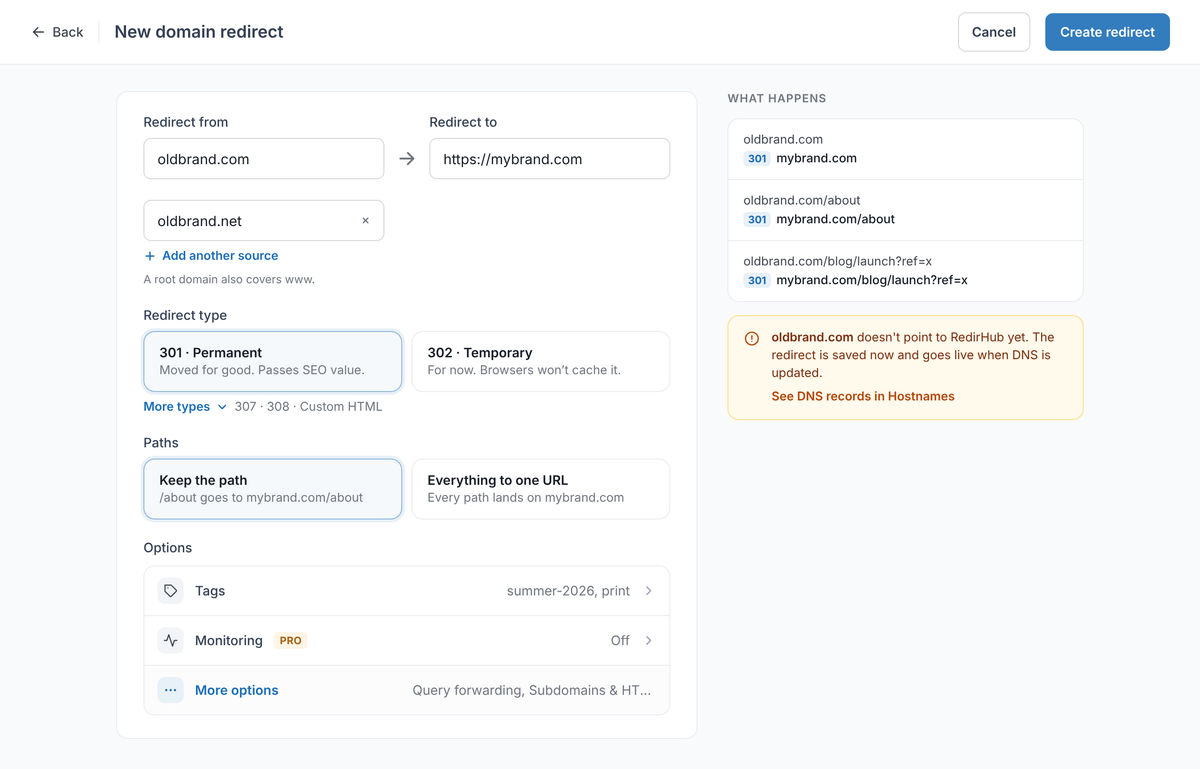
Check What happens before you click Create redirect.
Before you save, read the What happens panel on the right. It previews real requests with your settings, so you can confirm that a deep page such as oldbrand.com/about lands on mybrand.com/about with a 301, and that query strings like ?ref=x come along, without waiting for DNS. If the source domain does not point to RedirHub yet, a yellow note says so: the redirect is saved anyway and goes live as soon as DNS is updated (Step 4).
Click Create redirect. The redirect is saved and starts working as soon as DNS points to RedirHub.
Step 4: Point your DNS to RedirHub#
Open Hostnames, select the domain and use Connect DNS. Automatic setup handles the records for you at supported DNS providers; everywhere else, the Manual tab lists the exact records to add and the old ones to delete.
- Root domain (oldbrand.com): the A record shown, plus the TXT record for verification.
- Subdomains, including www (www.oldbrand.com, go.oldbrand.com): a CNAME record.
- Remove any other A, AAAA or CNAME records for the same names, otherwise some visitors keep reaching the old server.
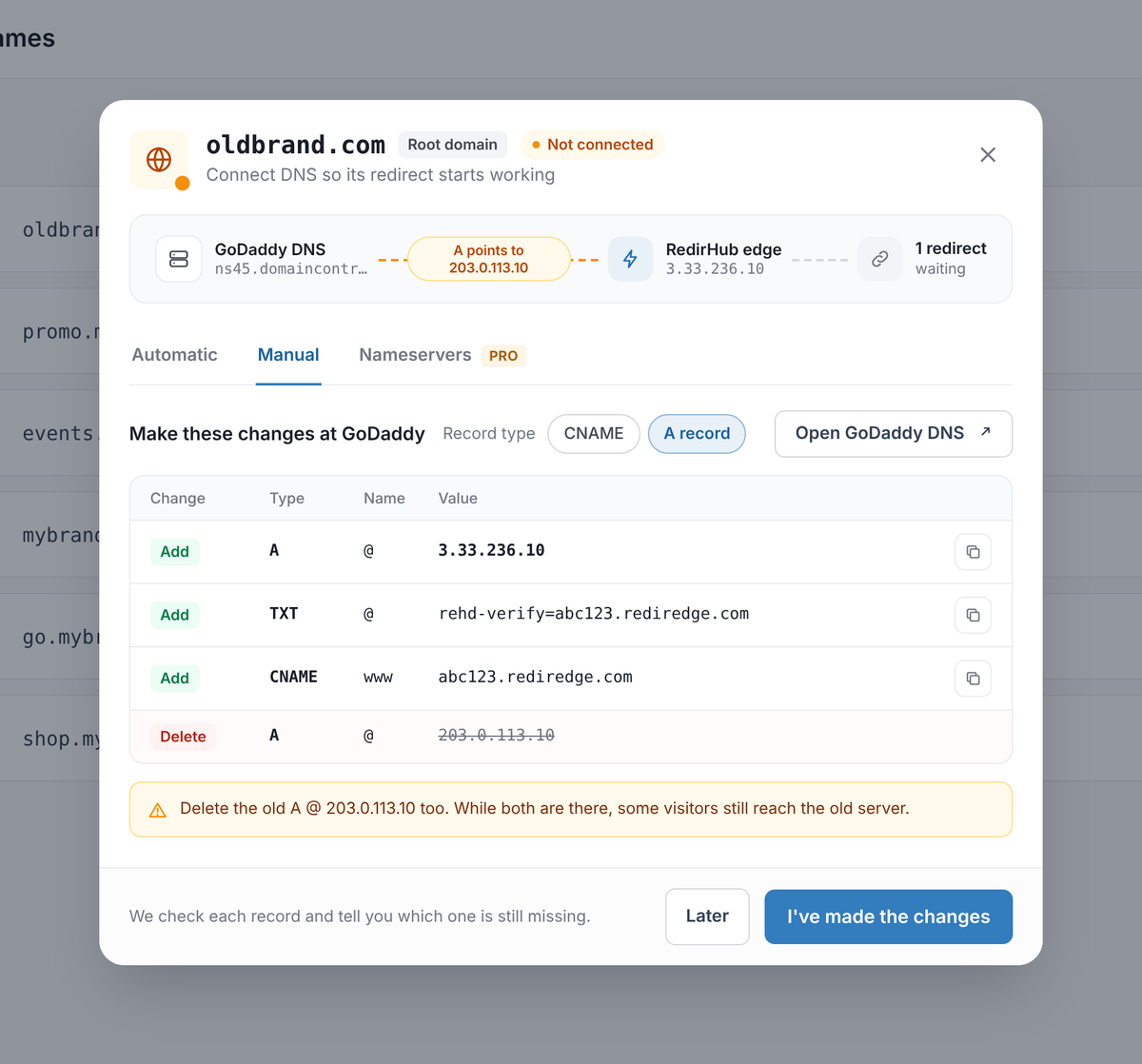
Connect DNS → Manual lists every record to add and delete. Your values are shown in your own dashboard.
Make the changes at your DNS provider, then click I've made the changes. RedirHub checks each record and tells you which one is still missing. Nameservers, MX (email) and every other record stay as they are.
More detail in What DNS changes are needed. Provider guides: GoDaddy, Cloudflare, Namecheap and more in the Support center.
Step 5: Wait for DNS verified and HTTPS#
DNS changes can take up to 24 hours to spread, and RedirHub detects them automatically. When your domain shows DNS verified, the redirect is live. The SSL certificate is then issued on its own and the status changes to Secured. See How long does the DNS change take? and Automatic HTTPS.
Most domains are quicker than that: a typical domain is confirmed about a quarter of an hour after it is added, and about three in four domains that connect do so within the first hour (RedirHub platform data, October 2026).
Step 6: Test your redirect#
Open your old URL in a private browser window and check the homepage, a deeper page such as oldbrand.com/about, and the www version. To see the status code, where it lands and how fast it answers, run the old URL through our redirect speed test. If something doesn't work yet, see Troubleshooting new redirects.
Is your redirect working? Enter your domain. You'll see the status code (301 or 302), where it lands, whether HTTPS is valid, and how fast it answers from Washington, Frankfurt and Tokyo, ranked against every redirect tested in the last 7 days.
Test my redirectRegistrar forwarding vs RedirHub#
Registrar forwarding is free and fine for a single spare domain. RedirHub is built for redirects you depend on:
| Registrar forwarding | RedirHub | |
|---|---|---|
| Where it runs | The registrar's forwarding server | 130 global edge locations (PoPs), close to each visitor |
| DNS and email | Some registrars take over the domain's records or nameservers | Stay where they are; only the root and www records change |
| HTTPS | Depends on the registrar | Issued and renewed automatically for root and www |
| Paths | Often one destination for everything | Keep the path, or map each old URL to its own new page |
| Many domains | One forward at a time | Several source domains per redirect; CSV import on every plan |
| Redirect types | Usually 301, 302 and masking | 301, 302, 307, 308 and frame redirects |
| Analytics | Usually none | Clicks and unique visitors with bots filtered out; top links per domain |
| Price | Usually included with the domain | From $49/month (Core); 14-day free trial on Pro |
Because RedirHub answers the requests itself, you can cancel hosting that only existed to redirect, get automatic HTTPS on every source domain, and manage a whole portfolio of forwarded domains in one list. DNS is re-checked every 10 minutes, so a record someone changes by mistake shows up quickly. If you only need one parked domain to forward to your homepage and your registrar's forwarding already works over HTTPS, the free option is enough.
Frequently asked questions
No. A redirect for the root domain also covers www, including the same paths, as long as www points to RedirHub in DNS. Add www as a separate source only if it should go to a different destination.
No. Your domain stays with your current registrar and DNS provider. You only change the DNS records for the names you want to redirect.
No. RedirHub answers the requests for your domain and handles HTTPS, so you can cancel hosting that only existed to redirect.
Usually minutes, but DNS changes can take up to 24 hours to spread. RedirHub detects the change automatically, shows DNS verified, and then issues the SSL certificate.
Use a 301 when the move is permanent, such as a domain change or a page that has a new home. Use a 302 when the old URL will come back, for example during maintenance or a short test. If you are not sure, a 302 is easy to switch to 301 later.
Not with standard records. A, AAAA and CNAME records only decide which server answers; the redirect itself is an HTTP response that a server has to send. Registrar forwarding and redirect services such as RedirHub work by pointing your DNS at a server that sends that response.
A permanent redirect to the closest matching page is the recommended way to move a URL, and search engines pass its signals on to the new address. Problems come from redirecting everything to the homepage, long redirect chains, or leaving a 302 in place for a permanent move.